
Supply Chain Consulting for CEOs, Private Equity, and Manufacturing Leaders
Former Operations Leader delivering hands-on execution to reduce risk, unlock cash, and prepare operations for growth, acquisition, or exit.
You likely need this if…
-
Your EBITDA is constrained by operational inefficiencies
-
Supply chain disruptions are hitting service or margin
-
Inventory is tying up cash
-
Growth is outpacing operational capability
-
You’re preparing for a transaction (buy or sell)


Defining an effective supply chain and manufacturing strategy requires answering a set of critical questions:
-
What capabilities should be built and retained in-house versus outsourced?
-
How can inventory be optimized to balance service, cost, and cash flow?
-
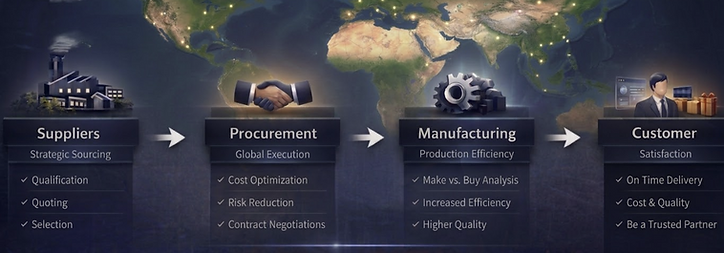
How should the supply chain network be structured—from suppliers through production to distribution?
-
Where is dual sourcing or redundancy required to mitigate risk and ensure continuity?
CASE STUDY IN SUPPLY CHAIN COST REDUCTION


Situation
Following a carve-out, an electronics division lacked a defined supply chain and procurement function. The business needed to establish sourcing capabilities, reduce inventory exposure, and mitigate supply risks impacting production, revenue, and customer satisfaction.
Approach
Built foundational procurement and supply chain processes, including structured RFQs, supplier development, and reduction of single-source dependencies. Implemented vendor-managed inventory programs and strengthened relationships with key suppliers to improve continuity and flexibility.
Impact
-
Delivered 2–3% annual cost savings (>$1M per year)
-
Reduced single-source components from ~80% to <20% on key BOMs
-
Lowered supply chain risk and improved production continuity
-
Improved cash flow through vendor-managed inventory programs
CASE STUDY IN INVENTORY REDUCTION
Situation
Inventory at a multinational distributor was growing faster than sales, tying up cash and increasing risk. There was no structured process to identify or reduce excess, obsolete, or slow-moving inventory.
Approach
Partnered with Sales and Operations to identify slow-moving inventory and drive targeted disposition, prioritizing sell-through. Implemented a formal S&OP process to improve forecasting discipline, prevent unnecessary purchasing, and introduce approval controls.
Impact
-
Inventory days reduced by 40% in under one year
-
Slow-moving inventory reduced by two-thirds
-
Significant cash unlocked and improved working capital performance
Global Experience
